
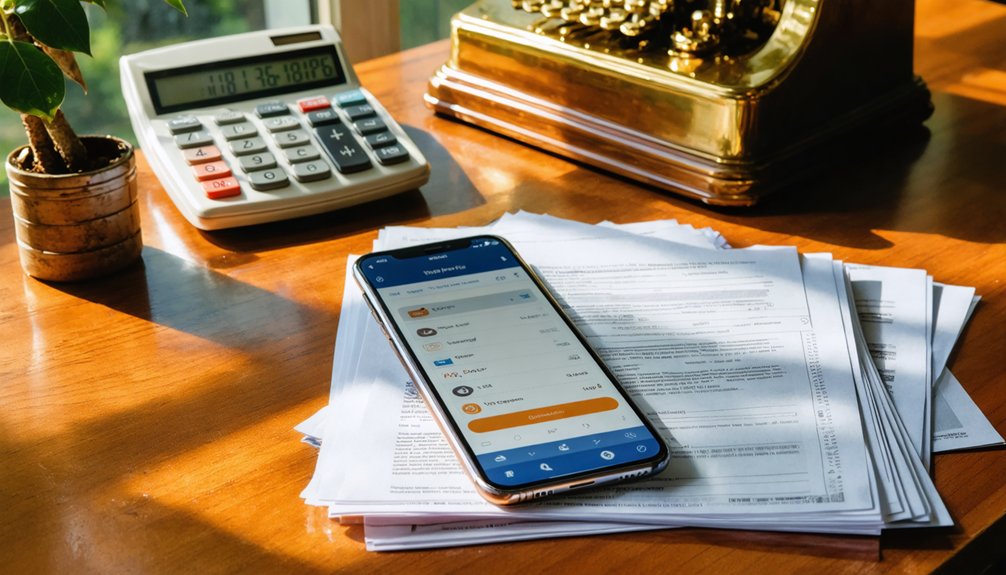
Bill‑pay loans are short‑term, installment‑based products that automate bill settlement, offering higher limits and lower APRs than payday loans but still exceeding rates of traditional personal loans or credit cards. Unlike basic bill‑pay services, they disburse funds instantly and match payments to invoices, often with escrow protection. Secured options reduce rates, while unsecured ones rely on credit scores. Compared with invoice financing, they serve consumers rather than businesses. Understanding fees, repayment structures, and lender credibility is essential before proceeding.
Key Takeaways
- Bill‑pay loans offer fixed monthly installments (1‑5 years) with APRs 6‑36 %, unlike payday loans’ 2‑4‑week lump‑sum repayment and 300‑400 % APRs.
- Unlike traditional bill‑pay services, bill‑pay loans disburse funds instantly to digital wallets and automate payment matching to invoices.
- Secured bill‑pay loans can lower rates and increase limits, while unsecured versions rely on credit scores (≥ 670) and income verification.
- Personal installment loans provide predictable amortization and lower total interest than credit cards, whereas bill‑pay loans may be higher cost but offer structured repayment for large expenses.
- Payday loans bypass credit checks and use post‑dated checks, creating rollover debt traps; bill‑pay loans require credit evaluation, reducing default risk.
What Exactly Pay Loans Actually Are
Pay loans are short‑term, high‑cost credit products typically limited to $500 or less, with repayment due in a single lump sum on the borrower’s next payday or income receipt. They exemplify short term lending, often funded through check cashing arrangements that deliver cash, a check, or a prepaid card. The loan amount is capped at $500 in most jurisdictions, with fees ranging from $10 to $30 per $100 borrowed, producing APRs near 400 % for a two‑week term. Underwriting bypasses credit checks, relying solely on the borrower’s anticipated income. Repayment is secured by a post‑dated check or electronic debit authorization, which the lender cashes or withdraws on the due date. Some states permit rollovers or renewals, extending the due date while adding additional fees. Convenient scheduling can help borrowers avoid missed payments. Online bill pay services can also be used to automate the repayment of these loans, reducing the risk of missed due dates. State caps often limit the maximum fee per $100 borrowed.
How Bill Pay Loans Differ From Traditional Bill‑Pay Services
Distinguishing bill‑pay loans from traditional bill‑pay services begins with recognizing their core purposes: the former provides short‑term credit to cover upcoming expenses, while the latter is a scheduling tool that moves existing funds from a consumer’s account to a creditor.
Bill‑pay loans embed payment automation within a credit line, allowing borrowers to trigger disbursement and repayment in a single workflow, whereas traditional services rely on manual or recurring transfers.
The loan model often integrates account reconciliation, automatically matching disbursed amounts to invoice identifiers, while bill‑pay services simply record a debit.
Digital wallets may receive loan proceeds for instant use, contrasting with the conventional routing of funds to banks.
Escrow services can hold loan‑funded payments until verification, a safeguard not inherent to basic bill‑pay scheduling.
BNPL can increase sales by offering interest‑free installments, which may affect a business’s cash flow planning when using bill‑pay loans.Automatic payments reduce the risk of missed due dates and associated fees.Convenient scheduling allows users to set up recurring payments without manual intervention.
Secured vs. Unsecured Loans: Which Fits a Bill‑Pay Need?
A secured loan ties the loan to a collateral valuation—such as a savings account, vehicle, or stock portfolio—allowing lenders to offer lower interest rates and higher borrowing limits. Because risk is mitigated, credit requirements are less stringent, though approval may take longer due to asset appraisal. Asset ownership is required, which can limit eligibility for borrowers who do not possess valuable assets. Unsecured loans require no collateral and rely on creditworthiness and income, often demanding a good FICO score (≥670) and resulting in higher APRs ranging from 7 % to 36 %. Both structures provide repayment flexibility, but secured options reduce cost and increase available amounts, while unsecured alternatives avoid asset seizure risk and suit borrowers without valuable collateral.
Payday Loans vs. Bill Pay Loans: Cost and Risk Comparison
Comparing payday loans with bill‑pay (personal) loans reveals stark differences in cost and risk. Payday products charge APRs of 300 %–400 % (up to 662 %) and flat fees of $10–$30 per $100 borrowed, producing effective rates above 150 % on a $500 loan. In contrast, bill‑pay loans range from 6 % to 36 % APR, with installment caps at 200 % and higher limits up to $50,000.
Payday terms are short‑term, due in 2–4 weeks, providing limited short‑term affordability but forcing lump‑sum repayment and often leading to rollover debt traps. Bill‑pay loans offer repayment flexibility through fixed monthly installments over 1–5 years, reducing default risk.
Credit checks for personal loans add a modest underwriting barrier, while payday loans skip credit evaluation, increasing exposure to high‑cost borrowing cycles. High‑cost fees make payday loans financially risky.
Invoice Financing vs. Bill Pay Loans: Business vs. Consumer Focus
Why do businesses and consumers turn to such different financing tools? Invoice financing targets B2B firms with unpaid invoices, using invoice volume and customer credit for qualification rather than the company’s credit history. It provides working‑capital tied to earned revenue, often via invoice securitization, and limits exposure through customer concentration caps (typically 15 %). Advance rates range 80‑95 %, and funds are released within 1‑5 days.
Bill‑pay loans, by contrast, serve individual consumers covering personal bills such as utilities or rent. Qualification relies on personal credit and income, with fixed‑rate repayment schedules and no collateral linked to receivables. These loans address household cash‑flow gaps, are disbursed instantly through apps, and carry higher APRs.
The divergent focus reflects distinct cash‑flow needs, risk profiles, and underwriting criteria.
Fixed‑Rate, Variable‑Rate, and Non‑Amortizing Options for Bill Pay Loans
When selecting a bill‑pay loan, borrowers must weigh fixed‑rate, variable‑rate, and non‑amortizing structures, each presenting distinct trade‑offs in predictability, cost, and repayment timing. Fixed‑rate loans lock the interest rate for the entire term, creating a stable amortization schedule and shielding borrowers from rate volatility.
Variable‑rate loans tie payments to benchmarks such as prime or SOFR, causing periodic adjustments that can lower early costs but expose borrowers to higher payments if market rates rise. Non‑amortizing options defer principal repayment, often requiring a balloon payment at maturity; this reduces short‑term cash outflow but can increase overall interest expense and complicate budgeting.
Choosing among these structures depends on loan horizon, risk tolerance, and expectations about future rate movements.
When to Choose a Bill Pay Loan Over Credit Cards or Direct Payments?
A borrower facing a high‑balance credit‑card debt, a large one‑time expense, or a need to consolidate multiple balances may find a bill‑pay loan more advantageous than revolving credit or direct payments.
Fixed, monthly installments create budget predictability that credit‑card payments lack, especially when balances fluctuate and APRs hover at 20‑25 %.
When the priority is cost certainty, a personal loan’s 12‑84‑month term and 11‑13 % rate reduce total interest compared with credit‑card accruals.
However, this predictability comes with reward tradeoffs: credit cards often provide cash‑back, points, or travel miles absent from loans.
Choosing a bill‑pay loan is prudent when the borrower values a structured repayment schedule and lower long‑term expense over immediate rewards.
Key Red Flags and How to Avoid Overpaying on Bill‑Pay Financing
During the loan‑selection process, borrowers should scan for hidden fees, inflated rates, opaque terms, and fraud signals that can turn a seemingly affordable bill‑pay loan into a costly trap.
Key red flags include undisclosed application or origination fees, prepayment penalties, and late‑payment surcharge chains that inflate total cost.
Fraud indicators appear as pressure to omit income data, incomplete sections, unusually high income claims, and poor‑grammar documents.
To avoid overpaying, borrowers must verify lender identity through official channels, request full documentation, and calculate the total cost over the loan life.
Reject unconventional payment methods such as gift cards or Bitcoin, and employ fraud‑monitoring tools.
Transparent, documented terms and clear credit‑reporting policies safeguard against hidden fees and predatory practices.
References
- https://corporatefinanceinstitute.com/resources/commercial-lending/loan-features/
- https://hfsfcu.org/education/what-is-bill-pay/
- https://www.nerdwallet.com/banking/learn/online-bill-pay-what-it-is-why-you-should-use-it
- https://www.consumerfinance.gov/ask-cfpb/what-is-a-payday-loan-en-1567/
- https://www.bill.com/learning/invoice-financing
- https://www.syncupbookkeeping.com/glossary/b/bill-pay
- https://www.ellsworth.af.mil/Portals/146/9_ Payday Loan.pdf
- https://www.sofi.com/learn/content/how-does-bill-pay-work/
- https://squareup.com/us/en/legal/general/billpay
- https://www.bankrate.com/banking/checking/online-bill-pay-what-is-it-why-its-a-good-idea/